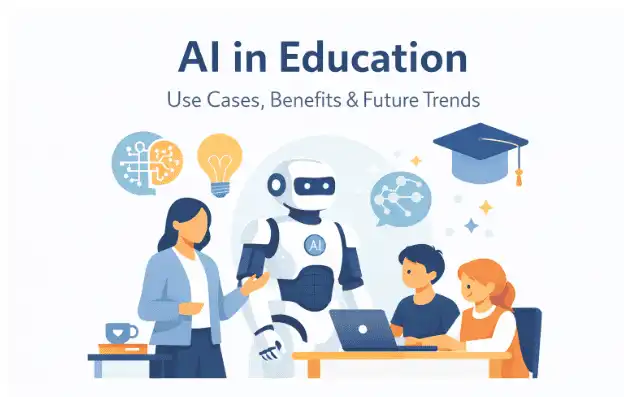
Today, people learn, teach, and train in an ever increasing number of technology driven ways. Educational institutions and organizations that train employees rely on digital platforms to personalize learning experiences, automate repetitive tasks such as grading and reporting, and track learner progress to deliver timely and relevant feedback.
As a result of this shift, many institutions move from experimental tools to production ready learning platforms that must scale, remain secure, and deliver measurable outcomes. To achieve this, organizations increasingly collaborate with experienced educational app development company that can design AI enabled learning systems tailored to real users, real data, and long term growth.
Decision makers typically encounter the same issue when hearing about AI as it relates to education: they find it difficult to correlate the technical capabilities that AI offers with tangible examples of its use, measurable benefits, and sustainable strategies for building educational platforms around it today and into the future. This article describes the different ways in which AI technologies are currently being deployed in the educational setting; the types of value that those technologies have provided; and the future trends that will help to shape learning platforms in the next several years.
Why traditional learning systems struggle to scale
Modern education must support diverse learners at scale. Traditional learning management systems rely on static content, manual assessments, and limited analytics. These constraints create several recurring issues:
- Learners progress at different speeds but follow the same curriculum
- Instructors spend time on grading and reporting instead of teaching
- Engagement drops in remote and self paced formats
- Administrators lack data to prove learning effectiveness
AI addresses these challenges by adding intelligence to learning workflows. It supports decision making, adapts content, and processes data faster than manual systems ever could.
Core AI use cases in education platforms
AI delivers the most value when it supports the entire learning lifecycle. Effective platforms combine several AI driven capabilities instead of relying on a single feature.
Personalized learning paths
AI observes learner behavior, assessment results, and interaction patterns to adjust learning paths in real time. The system recommends content difficulty, pacing, and next steps based on actual performance.
An approach which encourages long term retention and lessens learner frustration. With less time spent reviewing “known” content, learners are able to spend more time reinforcing those areas where they are weak. In the world of corporate training, personalisation allows for the ability to align the learning experience with a learner’s specific job and/or skill set.
From a technical standpoint, personalization relies on clean data pipelines and transparent recommendation logic. Teams usually design these systems so instructors can review and adjust AI decisions.
Intelligent tutoring and virtual assistants
AI tutors are available at all times and support students by answering their questions, explaining concepts, and helping them complete tasks using natural language. Virtual tutors provide greater overall learning continuity (by having fewer interruptions) while decreasing the amount of time that an instructor has to be present for the student.They typically provide hints and explanations rather than giving direct answers.When integrated into the learning interface, tutors decrease friction and improve student engagement compared to using a separate chatbot tool.
Automated assessment and feedback
Assessment automation remains one of the most widely adopted AI use cases. Systems grade quizzes, analyze written responses, and evaluate spoken language using predefined criteria.Fast feedback helps learners correct mistakes early. Instructors save time and maintain consistency across large cohorts. In regulated environments, AI assessment systems also provide audit trails that explain how results were generated.
Learning analytics and performance insights
AI Models use the data from learners such as completion rates/engagement levels/knowledge gaps to create Data Driven Insights. Platforms are able to identify risk indicators of drop offs/underperformance early and share this information with instructors/academic administration/HR. This data driven approach allows instructors, administrators, and HR departments to make more informed decisions about course updates, learner support, and hiring workforce. Legacy platforms were designed without first being built around data, so therefore have trouble being able to analyse it; customised Learning Systems can do this effectively, as opposed to Legacy Platforms.
AI assisted content creation
AI helps educators create and adapt learning materials faster. Systems summarize content, generate practice questions, and localize materials for different audiences.This approach works best when AI supports human authors rather than replacing them. Educators remain responsible for accuracy, tone, and learning objectives while AI accelerates routine work.
Key benefits of AI in education
The adoption of AI results to a value that extends beyond efficiency in operations. Proper implementation of AI enhances learning quality and leads to better strategic outcomes.
Improved learning outcomes
Timely feedback and personalization improve retention and comprehension. Learners achieve better results with less wasted effort. Organizations that track outcomes often see higher completion rates and stronger post training performance.
Higher instructor productivity
With the introduction of automation into education, educators will have more time to devote to supporting their students, designing effective learning experiences, and meeting the unique needs of learners. Automation will enable instructors to create high quality educational institutions and programs within the corporate environment.
Scalable learning without quality loss
Due to their ability to support many learners while providing a personalized experience, AI based technologies are leading to increased scalability for educational programmes and organisations that operate on a global basis. An additional advantage of having custom designed platforms is that they tend to scale better since the infrastructure is designed specifically for the types of usage patterns being experienced.
Better visibility and decision making
AI powered analytics provide evidence of learning effectiveness and compliance. Leaders gain insight into skill development and training ROI, supporting broader digital initiatives across education and HR.
Challenges and risks to address early
AI adoption introduces risks that teams must manage deliberately:
- Data privacy and learner consent
- Bias in training data that affects recommendations
- Over automation without human oversight
- Integration complexity with existing systems
AI decisions are mostly bound by successful projects with clear boundaries imposed from the start and are also monitored through governance mechanisms.
Why custom development matters for AI driven education
Off the shelf learning platforms often limit AI customization, data access, and integrations. These constraints slow innovation and increase vendor dependency.
Custom development allows organizations to:
- Build AI features aligned with specific learning goals
- Integrate internal data sources and systems
- Control data ownership and compliance
- Evolve AI capabilities over time
Future trends shaping AI in education
A few of the trends impacting present day teams while developing educational platforms.
Multimodal learning analysis
Technologies of the upcoming times will perform a joint analysis of text, voice, video, and interaction data to have a more profound understanding of the two concepts that are engagement and comprehension.
Generative AI for adaptive content
Dynamic learning resources customized to learners, positions, and contexts will be generated by generative models. Validation and quality control will still be fundamental.
Continuous skill validation
AI will continue to be involved in the process of assessment and issuance of micro credentials that will persist over time rather than one-off examinations, hence validating abilities through the total learning data.
Stronger regulation and standards
With the increasing AI usage, the regulatory bodies are likely to come up with more explicit laws concerning transparency, fairness, and accountability. It is imperative for the platforms to incorporate such compliance in their design.
Conclusion
AI already delivers measurable value in education when applied with clear goals and proper system design. It improves personalization, scalability, and insight while supporting instructors rather than replacing them.
Organizations that invest in AI driven learning platforms gain the most value when they focus on real use cases, strong data foundations, and long term ownership. With the right approach, AI becomes a sustainable asset that supports learners and educators over time.
Published On: January 28, 2026
Last Updated : January 28, 2026